
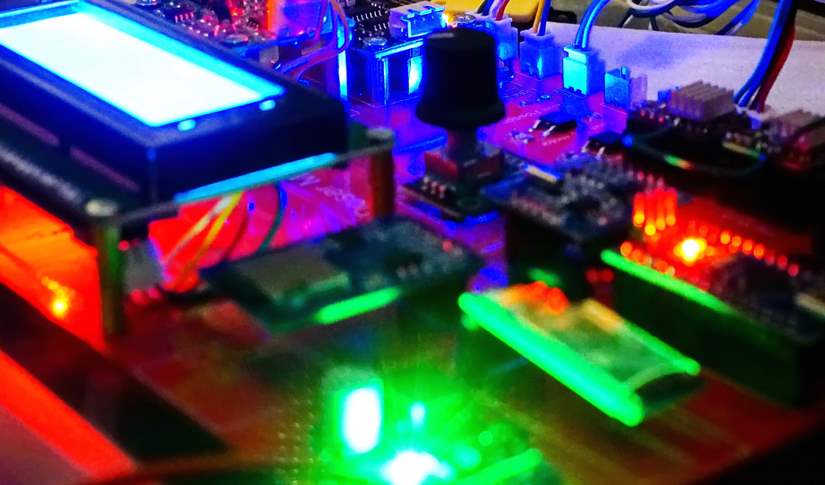
Microcontroller Development: Hardware & Firmware Engineering
Developing microcontroller-based systems requires tight integration of hardware and software engineering. In this comprehensive project, we developed a complete industrial IoT solution for Industry 4.0.
Project Overview
The goal was to develop a modular microcontroller system for:
- Machine data acquisitionSensor data in real time
- Edge computingLocal data processing
- Connectivity: Wi-Fi, Ethernet, LoRaWAN
- Energy efficiencyBattery-powered operation possible
Hardware architecture
Main components
- MCUARM Cortex-M4 (STM32F407)
- Memory: 1MB flash memory, 192KB RAM, external EEPROM
- CommunicationMulti-Interface Design
- sensorsI2C/SPI bus systems
- power supplySwitching Regulator with LDO
Circuit design
System-Architektur:
┌─────────────────┐    ┌──────────────┐    ┌─────────────┐
│   Sensor Hub    │────│ Mikrocontroller │────│ Kommunikation │
│ - Temperatur    │    │   STM32F407    │    │ - WiFi      │
│ - Druck         │    │   168 MHz      │    │ - Ethernet  │
│ - Vibration     │    │   FPU          │    │ - LoRaWAN   │
└─────────────────┘    └──────────────┘    └─────────────┘
Firmware development
Real-Time Operating System
Implementation using FreeRTOS for multitasking:
// Task-Definitionen
void SensorTask(void *pvParameters) {
    TickType_t xLastWakeTime = xTaskGetTickCount();

    while(1) {
        // Sensordaten erfassen
        ReadAllSensors();

        // Daten verarbeiten
        ProcessSensorData();

        // Periodische Ausführung (100ms)
        vTaskDelayUntil(&xLastWakeTime, pdMS_TO_TICKS(100));
    }
}

void CommunicationTask(void *pvParameters) {
    while(1) {
        // Datenübertragung
        if(xQueueReceive(dataQueue, &sensorData, portMAX_DELAY)) {
            TransmitData(&sensorData);
        }
    }
}
Sensor interface
I2C sensor management
typedef struct {
    uint8_t address;
    SensorType_t type;
    uint32_t lastRead;
    float value;
    SensorStatus_t status;
} Sensor_t;

// Sensor-Array
Sensor_t sensors[] = {
    {0x48, TEMP_SENSOR, 0, 0.0f, SENSOR_OK},
    {0x77, PRESSURE_SENSOR, 0, 0.0f, SENSOR_OK},
    {0x53, ACCEL_SENSOR, 0, 0.0f, SENSOR_OK}
};

// Universelle Sensor-Lesefunktion
HAL_StatusTypeDef ReadSensor(Sensor_t *sensor) {
    uint8_t data[4];
    HAL_StatusTypeDef status;

    status = HAL_I2C_Master_Receive(&hi2c1, sensor->address << 1,
                                   data, sizeof(data), 1000);

    if(status == HAL_OK) {
        sensor->value = ConvertRawData(data, sensor->type);
        sensor->lastRead = HAL_GetTick();
        sensor->status = SENSOR_OK;
    } else {
        sensor->status = SENSOR_ERROR;
    }

    return status;
}
Communication stack
Wi-Fi integration
// WiFi-Konfiguration
typedef struct {
    char ssid[32];
    char password[64];
    uint8_t security;
    uint32_t timeout;
} WiFiConfig_t;

// MQTT-Client
void MQTT_PublishSensorData(SensorData_t *data) {
    char topic[64];
    char payload[256];

    // Topic generieren
    snprintf(topic, sizeof(topic), "sensors/%s/data", deviceID);

    // JSON-Payload erstellen
    snprintf(payload, sizeof(payload),
             "{"timestamp":%lu,"temperature":%.2f,"pressure":%.2f}",
             data->timestamp, data->temperature, data->pressure);

    // Nachricht senden
    MQTT_Publish(topic, payload, strlen(payload));
}
Power Management
Energy optimization
// Sleep-Modi implementieren
void EnterLowPowerMode(void) {
    // Peripherie deaktivieren
    HAL_SPI_DeInit(&hspi1);
    HAL_I2C_DeInit(&hi2c1);

    // GPIO auf Low-Power konfigurieren
    GPIO_InitTypeDef GPIO_InitStruct = {0};
    GPIO_InitStruct.Mode = GPIO_MODE_ANALOG;
    GPIO_InitStruct.Pull = GPIO_NOPULL;
    HAL_GPIO_Init(GPIOA, &GPIO_InitStruct);

    // RTC Wakeup konfigurieren
    HAL_RTCEx_SetWakeUpTimer(&hrtc, 30, RTC_WAKEUPCLOCK_CK_SPRE_16BITS);

    // Stop-Modus aktivieren
    HAL_PWR_EnterSTOPMode(PWR_LOWPOWERREGULATOR_ON, PWR_STOPENTRY_WFI);
}
Battery monitoring
// Batteriespannung überwachen
float GetBatteryVoltage(void) {
    uint32_t adcValue;
    float voltage;

    HAL_ADC_Start(&hadc1);
    HAL_ADC_PollForConversion(&hadc1, 100);
    adcValue = HAL_ADC_GetValue(&hadc1);

    // Spannung berechnen (Spannungsteiler 1:2)
    voltage = (adcValue * 3.3f / 4096.0f) * 2.0f;

    return voltage;
}
Debugging and testing
Hardware-in-the-Loop Testing
- Automated testsPython-based test suites
- Signal generatorsStimulating inputs
- Oscilloscope integrationAutomatic signal analysis
- Climate chamberEnvironmental tests
Software debugging
// Debug-Makros
#ifdef DEBUG
    #define DBG_PRINTF(fmt, ...) printf("[%lu] " fmt "rn", HAL_GetTick(), ##__VA_ARGS__)
    #define DBG_ASSERT(expr) if(!(expr)) { DBG_PRINTF("ASSERT: %s:%d", __FILE__, __LINE__); while(1); }
#else
    #define DBG_PRINTF(...)
    #define DBG_ASSERT(...)
#endif

// Performance-Monitoring
void ProfileFunction(void) {
    uint32_t startTime = DWT->CYCCNT;

    // Funktion ausführen
    CriticalFunction();

    uint32_t cycles = DWT->CYCCNT - startTime;
    float executionTime = (float)cycles / SystemCoreClock * 1000000.0f; // µs

    DBG_PRINTF("Function execution: %.2f µs", executionTime);
}
production validation
quality assurance
- Functional TestAll interfaces and functions
- Threshold testTemperature, voltage, timing
- EMV testingElectromagnetic compatibility and emissions
- long-term testing0-hour endurance test
calibration
// Sensor-Kalibrierung
typedef struct {
    float offset;
    float gain;
    float nonlinearity[3]; // Polynomkoeffizienten
} CalibrationData_t;

float CalibrateValue(float rawValue, CalibrationData_t *cal) {
    float corrected = rawValue * cal->gain + cal->offset;

    // Nichtlinearitätskorrektur
    corrected += cal->nonlinearity[0] * rawValue * rawValue;
    corrected += cal->nonlinearity[1] * rawValue * rawValue * rawValue;

    return corrected;
}
Results & performance
Technical specifications
- power consumptionmA active, 12µA in sleep mode
- data rate,000 samples per second and channel
- latency<1ms sensor-to-output
- accuracy: ±0.1% after calibration
- operating temperature-40°C to +85°C
scalability
The modular design allows for:
- sensor expansionUp to 32 I2C devices
- communication optionsPlug-in module
- Firmware updatesOver-the-Air (OTA)
- configurationWeb interface
Application areas
This microcontroller platform is ideal for:
- Predictive MaintenanceMachine condition monitoring
- Environmental monitoringAir quality, weather
- Smart BuildingBuilding automation
- agriculturePrecision Farming
Conclusion
The successful development underscores the importance of a holistic approach. By tightly integrating hardware and firmware engineering, we’ve created a high-performance, energy-efficient, and scalable IoT platform.
The modular architecture allows for quick adaptation to new requirements and supports various application scenarios.
Planning a microcontroller project? We support you from concept to production readiness!